
Research Basis
Applied Cognition is grounded in the relationship between environment, attention, cognitive load, regulation, and classroom readiness.
Applied Cognition uses research on cognitive load, teacher attention, classroom climate, neuroaesthetics, calm technology, and usability to guide product design. TILOTS applies this work through a calm classroom workflow for arrival, mood awareness, readiness, and reset modes.
A framework mapped
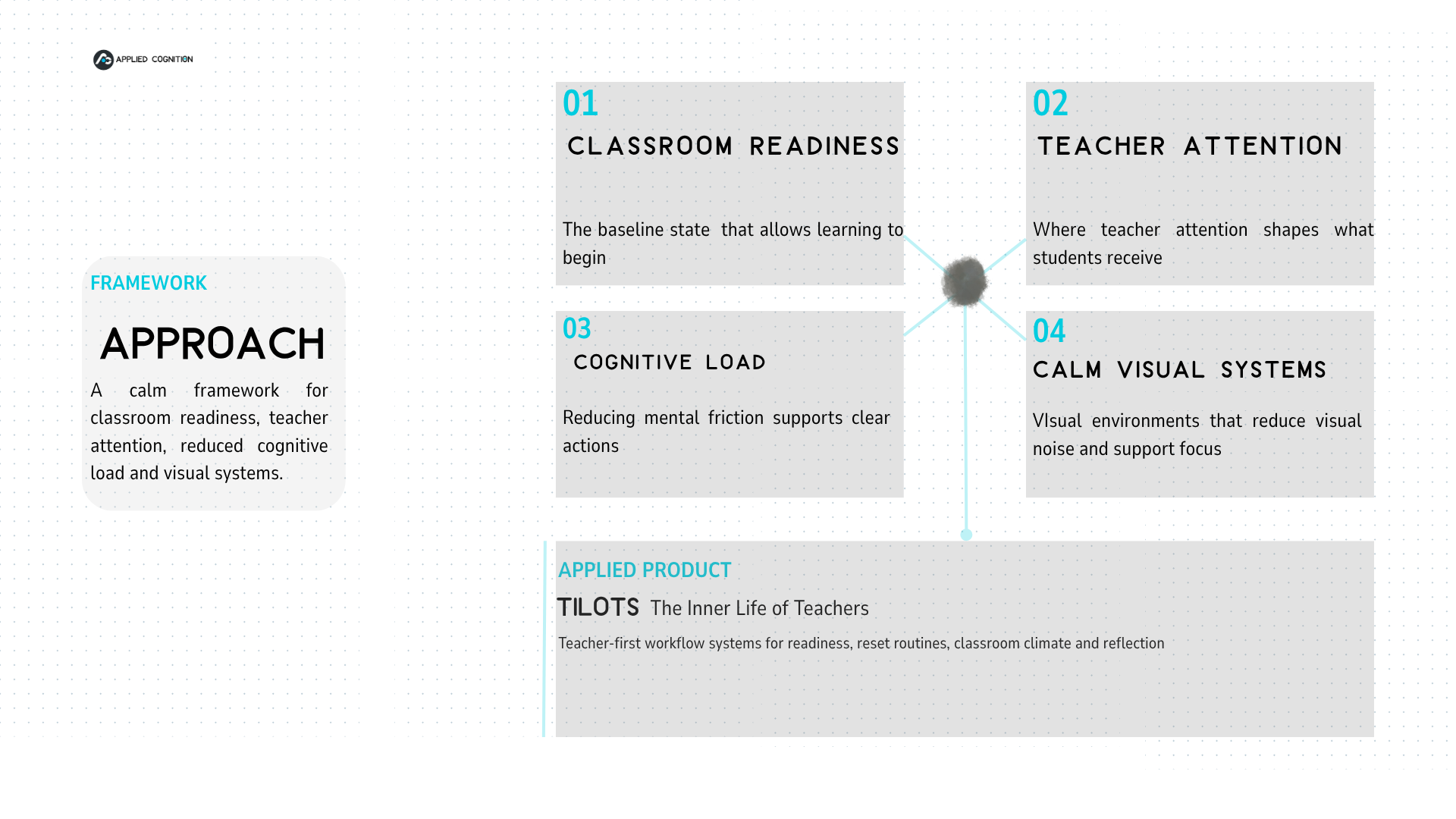
Applied Cognition begins with the learning environment. The physical room, digital tools, routines, and visual systems all shape what teachers and students must notice, ignore, remember, and regulate. TILOTS applies this approach through a classroom workflow that supports arrival, mood awareness, readiness, and reset modes.
2-minute research overview
A brief explanation of the research logic behind Applied Cognition and TILOTS.
A short overview of cognitive load, teacher attention, classroom readiness, and calm-by-design systems.
Core research areas
Cognitive load
Classroom systems should reduce unnecessary mental friction for teachers and students.
Teacher attention
Teacher attention is a limited classroom resource. Technology should protect it, not compete for it.
Classroom readiness
Arrival, mood awareness, and reset routines shape the conditions for instruction.
Calm visual systems
Visual environments can either increase noise or support clearer attention.
Neuroaesthetics
The design of physical and digital environments affects how people process, focus, and regulate.
Extended research explanation
A fuller walkthrough of the research foundation, including cognitive load, teacher attention, classroom climate, neuroaesthetics, and calm-by-design systems.
Now playing — Overview
Selected research basis
Applied Cognition draws from research in cognitive load, teacher attention, classroom emotional climate, emotional awareness, usability, calm technology, and neuroaesthetics. These sources do not claim that TILOTS has already been proven to improve outcomes. They explain the design foundation for calm, teacher-facing systems that reduce routine friction and protect attention.
Cognitive load and teacher attention
Teachers manage instruction, transitions, student needs, behavior, attendance, emotional climate, and technology at the same time. Cognitive load theory helps explain why extra clicks, dashboards, logins, alerts, and repeated decisions can compete with the attention teachers need for instruction and connection.
- Sweller, van Merriënboer, & Paas — Cognitive architecture and instructional design
- Education Endowment Foundation — Cognitive load theory: Research that teachers really need to understand
- UVA School of Education — The mental load of teaching
Teacher workload and well-being
Teacher workload is not only about hours worked. It includes the hidden mental load of planning, monitoring, responding, documenting, and switching between systems. Research on teacher well-being supports the need for tools that reduce routine friction rather than adding more tasks to the school day.
- RAND Corporation — State of the American Teacher / Teacher Well-Being reports
- Learning Policy Institute — Teacher working conditions and well-being research
- Jennings & Greenberg — The prosocial classroom model
Classroom emotional climate
Classroom climate shapes the conditions in which learning, conduct, and relationships unfold. Research on emotional climate and teacher-student relationships supports the idea that teachers need usable signals about readiness without turning classroom life into a behavior chart or surveillance system.
- Brackett, Reyes, Rivers, Elbertson, & Salovey — Classroom emotional climate and student conduct
- Pianta, Hamre, & Allen — Teacher-student relationships and engagement
- Oberle & Schonert-Reichl — Teacher burnout and student stress physiology
Social and emotional learning
SEL research shows that emotional awareness and supportive classroom conditions matter, but implementation quality matters. TILOTS should be framed carefully: it is not a full SEL curriculum or a therapy tool. It is a teacher-facing workflow system that supports mood awareness, reset routines, and classroom readiness.
- Learning Policy Institute — Evidence for Social and Emotional Learning in Schools
- CASEL — Social and Emotional Learning framework
- Durlak, Weissberg, Dymnicki, Taylor, & Schellinger — SEL meta-analysis
Mood awareness and emotional language
Simple mood check-ins can help students name how they are entering the room and give teachers a non-evaluative readiness signal. This should be presented as emotional language and classroom awareness, not diagnosis, therapy, or student surveillance.
- NAEYC — Teaching emotional intelligence in early childhood
- Brackett — Mood Meter / emotional intelligence work
- Denham — Emotional competence in young children
Recognition over recall and usability
Young learners and busy teachers should not have to remember unnecessary information just to begin a classroom routine. Usability research supports recognition-based interfaces, reduced navigation burden, and clear visual pathways, especially in environments where attention is already divided.
- Nielsen Norman Group — Recognition rather than recall
- Norman — The Design of Everyday Things
- Nielsen — 10 usability heuristics for user interface design
Calm technology
Calm technology argues that tools should require the smallest useful amount of attention. For classrooms, this means software should support the activity without becoming the activity. TILOTS uses this as a design principle: fewer interruptions, fewer competing signals, and clearer classroom flow.
- Weiser & Brown — The coming age of calm technology
- Amber Case — Calm Technology
- Mark Weiser — The Computer for the 21st Century
Neuroaesthetics and sensory environments
Research in neuroaesthetics, environmental psychology, and sensory design helps explain why visual clutter, lighting, sound, color, and spatial organization affect attention and regulation. Applied Cognition uses this lens to connect calm physical environments with calm digital systems.
- Kaplan & Kaplan — Attention Restoration Theory
- Ulrich — Stress recovery and environmental design
- Coburn, Vartanian, & Chatterjee — Neuroaesthetics and architectural experience
Full references are available on request.
Research-aligned, not overclaimed
Applied Cognition uses research to guide design decisions. TILOTS is built from evidence-informed principles about cognitive load, attention, emotional readiness, classroom climate, and low-friction usability. It is not presented as a clinical intervention, behavior tracker, or proven academic outcome tool.