
Neuroaesthetics
The design of a learning environment affects how people attend, process, and regulate.
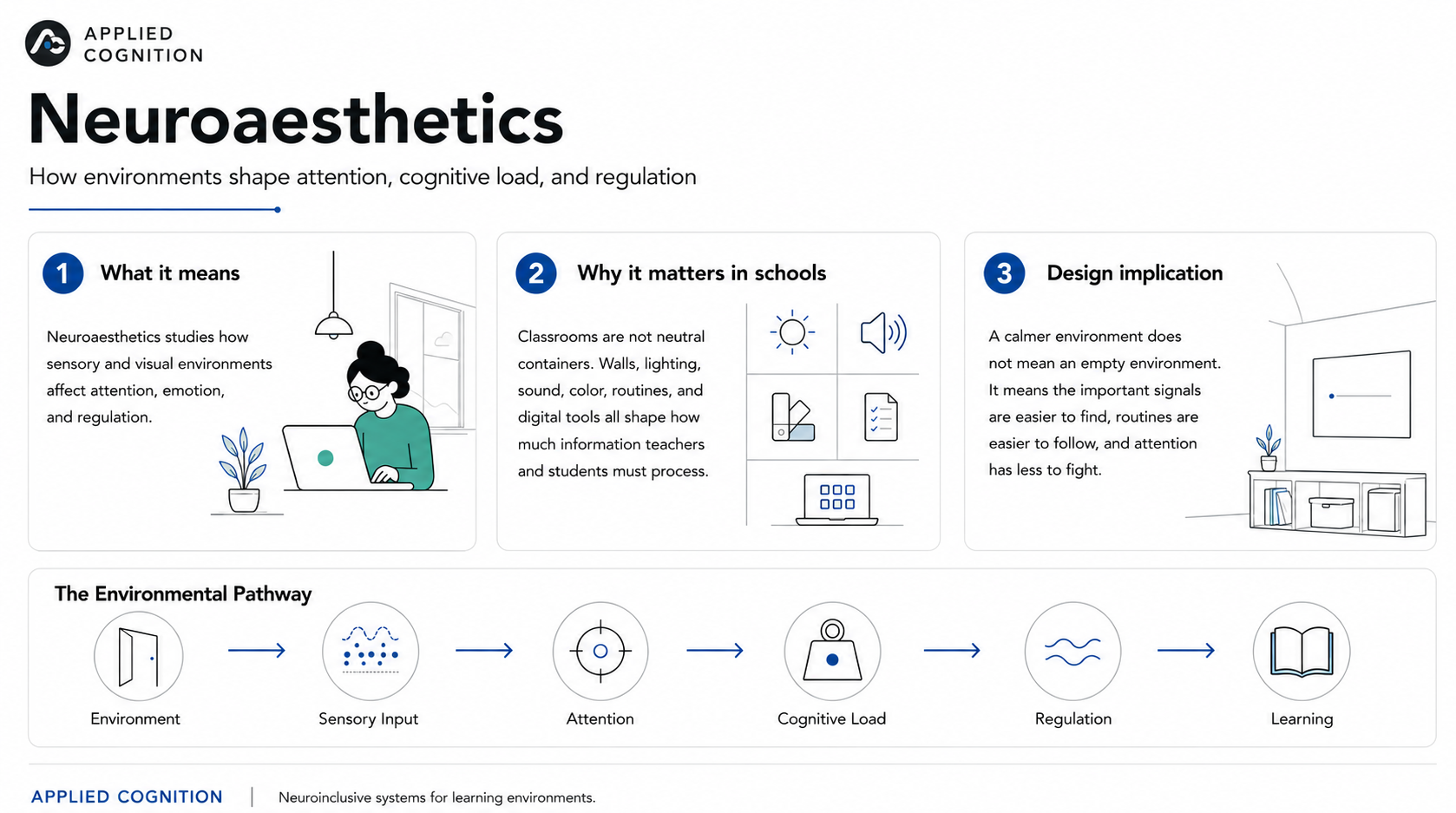
Neuroaesthetics helps explain why visual and sensory environments matter in schools. Classroom walls, lighting, sound, color, routines, and digital tools all shape the amount of information teachers and students must process.
Applied Cognition uses this lens to design calmer classroom systems. The goal is not decoration. The goal is to reduce unnecessary cognitive demand so teachers and students have more attention available for learning, connection, and classroom flow.
What neuroaesthetics means
Neuroaesthetics is an emerging field that studies how the brain, body, and behavior respond to sensory and aesthetic experience. In education, it helps explain why some environments feel calmer, clearer, or easier to work inside, while others feel visually loud or mentally demanding.
This does not mean classroom design is only about beauty. Visual order, natural patterns, lighting, sound, movement, and interface structure can affect how much attention and working memory people must use simply to function in a space.
A classroom is not a neutral container. It is part of the learning system.
How environments affect attention
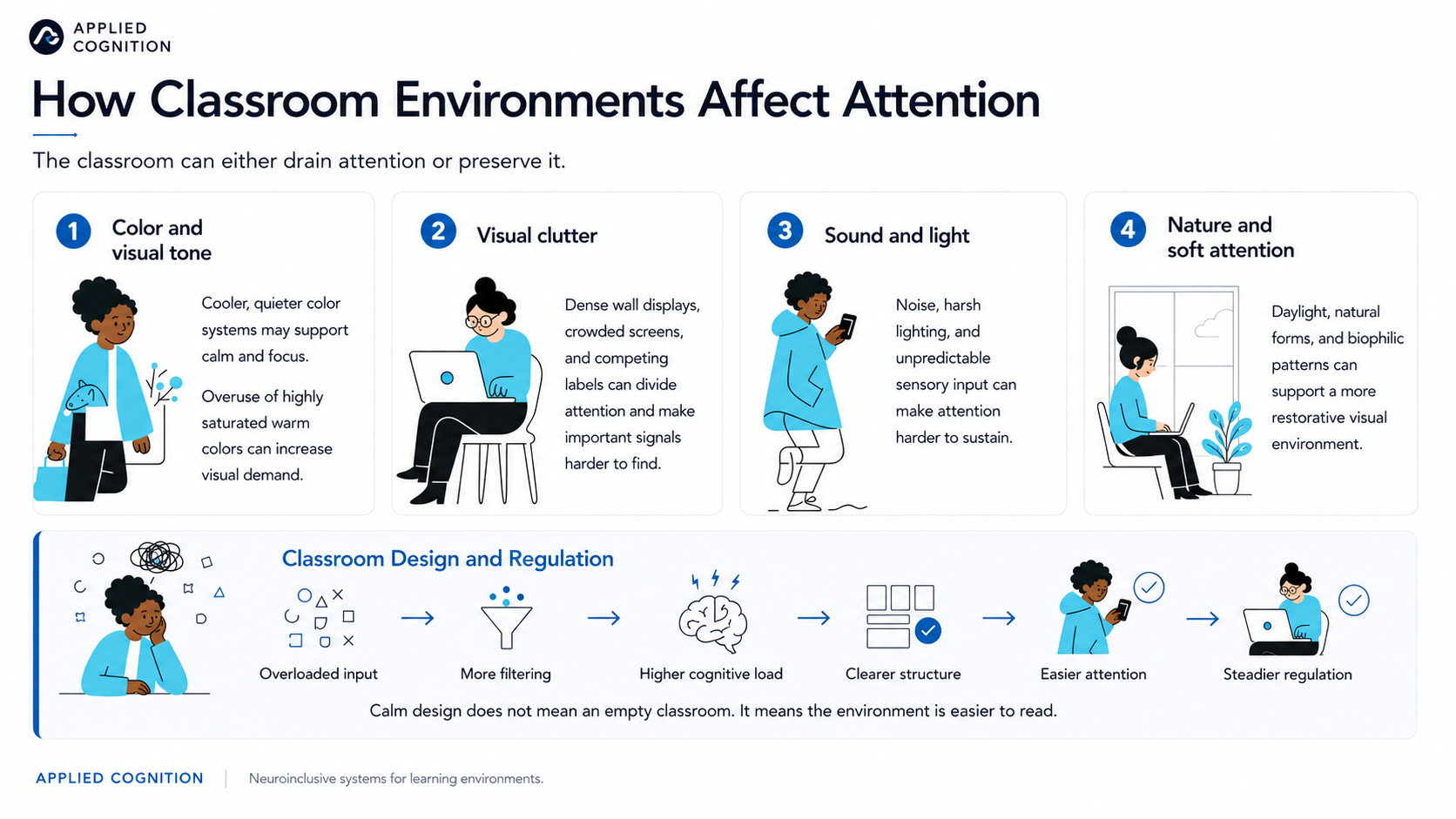
Color and visual tone
Research suggests that cooler, quieter color palettes may support calm, focus, and visual comfort. Highly saturated colors, especially when overused, can increase visual demand and make a space feel more stimulating than it needs to be.
Visual clutter
Dense wall displays, competing labels, crowded dashboards, and overloaded screens can divide attention. Even when each item is useful on its own, too many signals at once can increase the amount of information teachers and students must filter.
Sound and light
Noise, harsh lighting, and unpredictable sensory input can make it harder for students and teachers to sustain attention. These conditions can be especially demanding for neurodivergent learners, but they affect the whole classroom environment.
Nature and soft attention
Natural forms, daylight, organic patterns, and biophilic design can support a more restorative visual environment. These elements are often easier to process than dense, artificial, or highly fragmented visual fields.
Classroom design can support or disrupt regulation
Classrooms operate as sensory environments. When a room is visually dense, noisy, poorly lit, or difficult to navigate, students and teachers must spend more effort filtering the environment before learning can begin.
That extra filtering matters. It can increase cognitive load, divide attention, and make routine transitions feel harder than they need to be.
A calmer classroom does not mean an empty classroom. It means the environment is organized. The most important information is visible. Routines are easier to follow. Attention has less to fight.
Calm interiors need calm technology
A classroom can be designed for calm and focus, but the digital workflow can still create friction.
Extra clicks, repeated logins, complex dashboards, alerts, tool-switching, and crowded screens create another layer of cognitive demand. These small interruptions may seem minor in isolation, but across a school day they can become a constant drain on teacher attention.
Applied Cognition treats digital tools as part of the learning environment. If the room is designed to protect attention, the software should protect attention too.
How this connects to TILOTS
TILOTS is built from the premise that classroom technology should reduce cognitive load, not amplify it. It organizes arrival, mood awareness, readiness, and reset modes into a calmer workflow so teachers do not have to hold scattered classroom signals in memory.
TILOTS does not ask teachers to perform calm. It gives them a calmer system to work inside.
A clearer beginning to the classroom routine.
A low-friction way to notice how students are entering the room.
A teacher-facing layer for understanding what the room needs before instruction begins.
A structured path toward My Self Mode or My Unity Mode when the class needs a reset.
Research-aligned, not overclaimed
Applied Cognition uses neuroaesthetics as a design lens. Research suggests that reducing visual and digital clutter may help preserve cognitive bandwidth for teachers and students. Evidence from environmental psychology, attention research, and calm technology supports the design rationale for spaces and tools that minimize unnecessary sensory and cognitive demand.
TILOTS is not a clinical intervention, diagnostic tool, behavior tracker, or claim of proven academic impact. It is research-aligned classroom infrastructure designed to reduce routine friction and support calmer readiness workflows.
The current claim is design alignment: TILOTS is built from evidence-informed principles about attention, environment, emotional readiness, usability, and cognitive load.
Why designed spaces affect attention
Neuroaesthetics suggests that the spaces, screens, colors, sounds, and visual patterns around us shape how attention is directed and how much cognitive effort is required.
Research basis includes neuroaesthetics, architectural cognition, aesthetic learning, sensory design, and calm technology sources.
The brain looks for signal in a busy room
Students and teachers are always predicting what matters. A room that feels ordered and coherent can reduce ambiguity, making it easier to tell signal from noise.
Attention and reflection can work together
Calm, well-composed spaces may support a balance between outward attention and inner reflection — the mix learning often needs to hold focus, memory, and meaning together.
A room is judged in an instant
A classroom, screen, or display can feel clear or confusing before anyone consciously analyzes it. That first impression is one reason classroom and screen design matter.
Good design preserves cognitive energy
Attention is a limited budget. Visual clutter, harsh acoustics, and confusing layouts can drain it before a lesson begins. Calmer rooms leave more capacity for thinking and connection.
Form tells the brain how to move and think
Lines, paths, materials, and textures carry meaning. Organic forms can invite exploration, clear pathways can signal order, and natural materials can build warmth and trust — all of which shape how a classroom feels to work in.
Calm is a design condition
Calm does not happen only through personal effort. It is shaped by the room, the routines, the visual field, and the tools teachers are asked to use.
Applied Cognition designs for those conditions.